Umayyad Architecture: an Evolution of Past Traditions
Umayyad architecture is very heavily influenced by the preexisting traditions of the areas they expanded into. The two main influences come from the Byzantine and Sasanian empires. Small changes, however, are introduced and this is what serves as a reflection of their early ruling practices.
Largely, when the Umayyads expanded into a new area they kept the ruling structure the same and only replaced the top officials. This meant that the majority of the population of their newly conquered areas didn’t feel much of a change in the earlier years.1 Eventually, the Umayyads made changes from the top-down but for the first couple of years everything functioned similarly. When changes were made, they were done by making the language of the government, like their written documents, etc, in Arabic. Gradually, this change in language caused the government officials to either learn Arabic or be left behind as their surroundings continued to evolve around them.
There have been different arguments posed for why they chose this method of transition. Some argue that the early Umayyad Caliphs chose this method due to the learning curve that came from transitioning from tribal pastoralists to the rulers of vast lands with massive cities. Others have argued that this was the method that allowed for them to focus on expanding as far as possible without being held back by administrative changes.2
The Caliphs of the Umayyads ruled from Damascus and when a new region was brought into the fold, they would dispatch a governor chosen by the Caliph. This chosen governor was the new head of the conquered area. He could then decide who to appoint to other high government positions. These appointments were, again, all done under the pre-provided structure in place from the previous ruling power.
Why An Absorption Occured
](/silk-road//essays/umayyad-architecture/images/great-mosque.jpg)
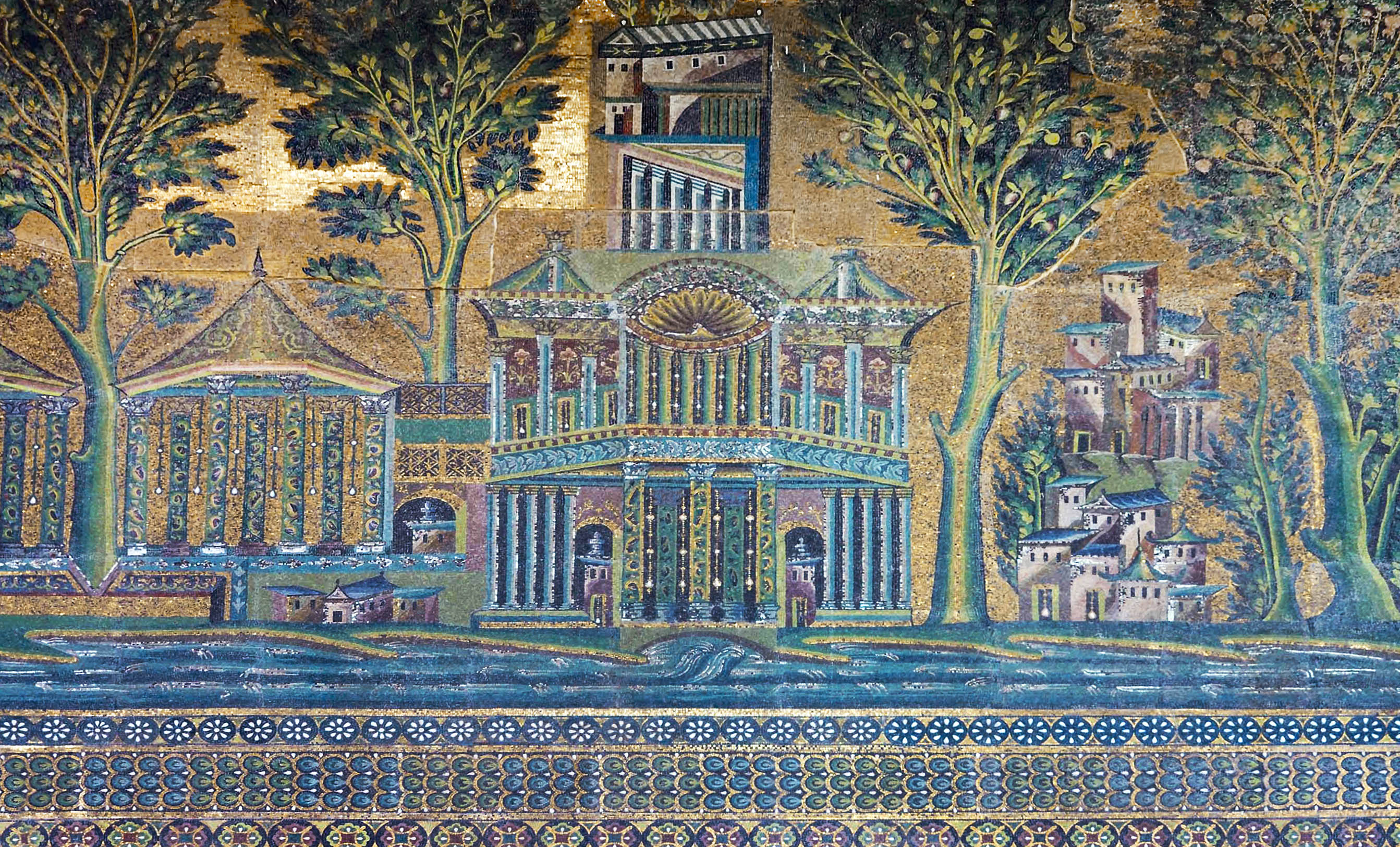
Artwork from the Great Mosque of Damascus. Source

The architectural manifestations of this ruling approach took a number of forms and even showcased the melding of cultures that was taking place. With the Umayyad Caliphate expanding and absorbing, it makes sense that an amalgamation of the cultures takes place. This is why in regions that the Sasanians never touched, their signifying marks are found in Umayyad architecture. One of the most prevalent manifestations of Sasanian influence is the stepped crenelations. These were placed along the tops of walls and became a staple in Islamic architecture even after the Umayyad Caliphate had come to an end.
An example of the artstyle from the Byzantine Empire can be seen with the design found on a wrestler’s weight. The lion present is incredibly similar to the lion depiction found at Qasr al-Mshatta.
Sasanian Influences
Kisra, or Khosrow I, was another major influence provided by the Sasanians. Prophet Mohammad was cited as praising the king for being a just ruler and his palace, Taq-i Kisra, has its echoes in Umayyad buildings. From Taq-i Kisra Umayyads got squinches, Khosrow I’s crown, arabesques, and iwans. A squinch is a dome placed upon a square or octagonal base which provides support. The crown is represented all throughout Islamic architecture and was used as a signifier of the muslims conquering the great Kisra.
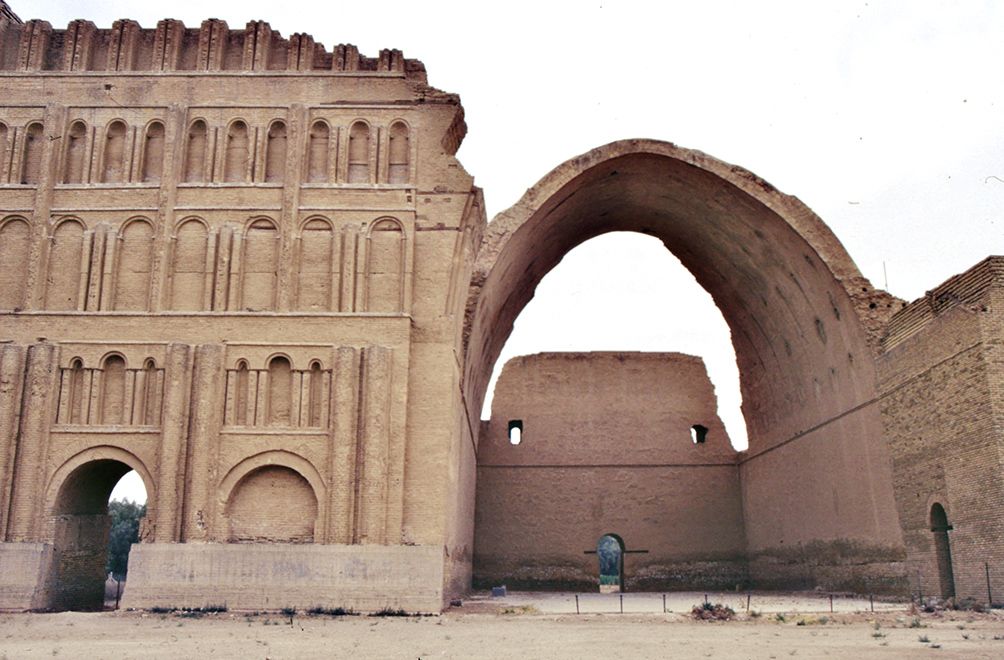
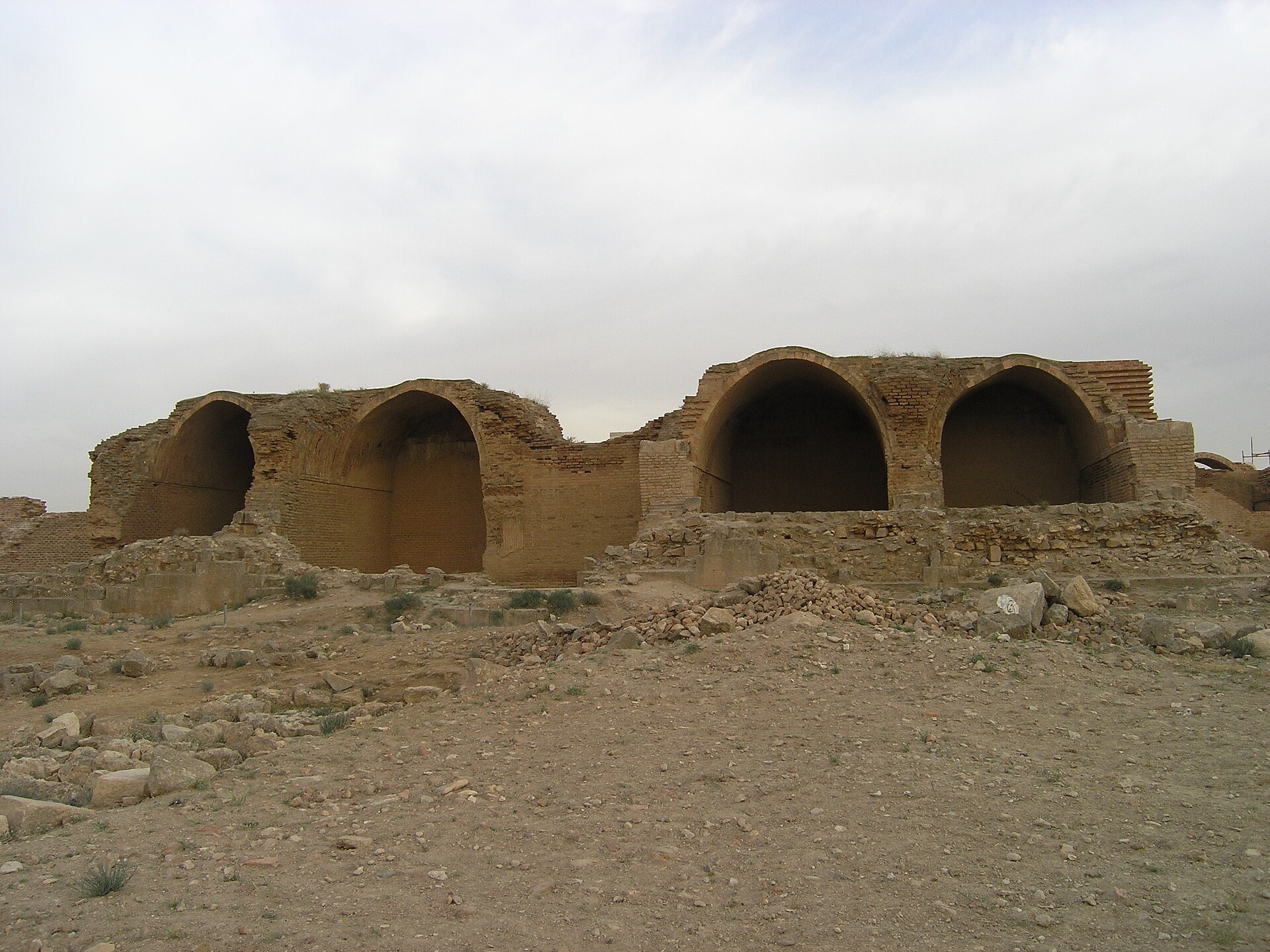
The Iwan at Taq-i Kisra vs iwans at Qasr al-Mshatta.
Iwans are rooms with three walls and a vaulted ceiling. The Sasanians got the idea of iwans from the Parthians of Iran but they evolved the concept into what the Umayyads worked off of. From the Byzantines the Umayyads got arches, mosaics, figurative imagery, and naves. Figurative imagery includes people, animals, and plants in their various art styles. Due to the fact that Damascus, the city the Caliphs ruled from, and many of their palaces are located in past Byzantine territories, the Byzantine influences tend to be overt than the Sasanian ones.
Umayyad Uniqueness
The novel additions made by the Umayyads is the inclusion of jewels to otherwise naturalistic depictions, the minbar and mihrab, and kufi. It is through the combination and additions that the Umayyads create a style of architecture that both continues the legacy of old powers and produces a new thing altogether. Umayyad architecture is a mirror of the way that their governmental styles took the old structures and made changes that benefited their goals as an Islamic conquering force. Their repurposing of not just styles but entire buildings, as is seen with the Great Mosque of Damascus, shows that the Caliphate was a product of their time and location. They did not exist in a vacuum that started when Prophet Muhammad received the revelations. The early Caliphs themselves were born as polytheists, the belief structure that came with that forged them into who they were. The same can be said for the people and lands that they conquered. They held within them the inescapable history of the context they grew up in, being under Umayyad rule did little to change that. It is important to keep in mind that it was not the Caliphs who were building these palaces and mosques, they were constructed by the people that were in the lands before them. Their knowledge and culture is forever embedded into the monuments, as are the ideals of the commissioners.
Byzantine traditions shown in the artwork at Khirbat al-Mafjar.
Bibliography
- Rabbat, Nasser. Residences, Castles, Settlements: Transformation Processes from Late Antiquity to Early Islam in Bilad al-Sham. Edited by Karin Bartl and Abd al-Razzaq Moaz. Rahden/Westfalen: Verlag Marie Leidorf GmbH, 2009.
- Sijpesteijn, Petra. Regime Change in the Ancient Near East and Egypt From Sargon of Agade to Saddam Hussein. Oxford University Press, 2007.
-
Petra Sijpesteijn, “Chapter 11. New Rule over Old Structures: Egypt after the Muslim Conquest,” in Regime Change in the Ancient Near East and Egypt From Sargon of Agade to Saddam Hussein, (Oxford University Press, 2007), 183. ↩
-
Nasser Rabbat, “Umayyad Architecture: A Spectacular Intra-Cultural Synthesis in Bilad al-Sham,” in Residences, Castles, Settlements: Transformation Processes from Late Antiquity to Early Islam in Bilad al-Sham ed. Karin Bartl and Abd al-Razzaq Moaz (Rahden/Westfalen: Verlag Marie Leidorf GmbH, 2009),14. ↩