Qasr al-Hary al-Gharbi Mosaic
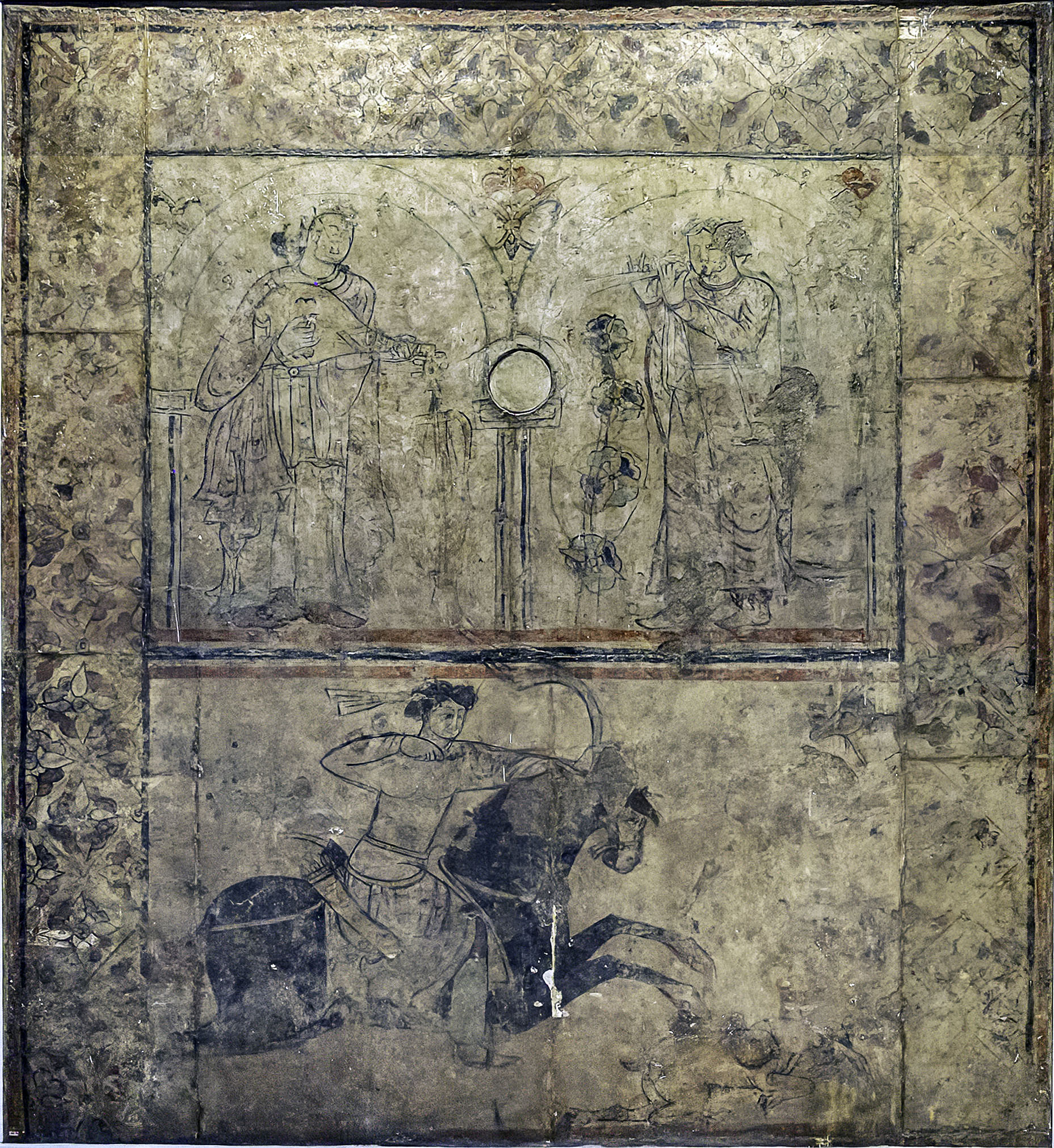
Any time there are state-funded depictions of people, like the ones present at Qasr al-Hayr al-Gharbi, it shows what the beauty standards of the time and place were. The specific section of artwork at hand shows three different people exemplifying various different skills.
Description
](/silk-road//objects/qasr-mosaic/images/qasr-mosaic.jpg)
Wall painting. Source

In the top left, a man is playing the oud, his head is facing to the center, and his eyes are cast in a downward diagonal. He is standing beneath an arch and is in front of what appears to be a vase. The paint on the entire work has faded a great deal, but colors like black, red, and blue are still somewhat visible. The oud player’s left foot is still visible and his shoes are red. His clothing is very loose and draping down his body, it appears that his outer cloak is red and that on top of his inner clothes, he has a belt. He does have an accessory of some kind atop his head.
Next to the oud player, separated by the beam of the arch, is a flute player. The wind instrument player is dressed and positioned similarly to his counterpart. The differences are that he is slightly shorter and his clothes don’t drape as much. His clothes seem to be red as well but there is less fabric giving him a more form fitting look. He is also wearing an accessory on his head. To the flutist’s right is a plant with four multicolored flowers. The plant is tall and winding as it almost reached below his shoulders.
Underneath the two musicians, a hunting scene unfolds. A man is on horseback with a bow and arrow chasing after two goats. There is a possibility of there being more prey that were erased due to weathering. He is dressed in the least amount of fabric out of the three displayed. No draping occurs and the outfit seems to be purely utilitarian, except for his hat which has an extra attachment which helps to express how fast the horse is moving. Additionally, he is wearing pants which are showcased due to his skirt riding up. He, like the other two, has a belt around his waist; he also has a full quiver attached by another belt. In his hand he has an arrow notched and at full draw. The rider is using stirrups; a Mongol invention that would have made it to Syria because of the Silk Road.
Analysis
This artwork, again, is an instance of self-aggrandizing found in Umayyad palaces. The extra fabric is a flaunt of wealth, the instruments are to exemplify their skills, and the archery to show their military prowess. All three men are depicted with asian characteristics, this is likely due to slave trade.1 In Islam, it is forbidden to enslave fellow muslims, this usually meant that Islamic powers would go to areas not under their control. Common regions for the capturing of slaves included Central Asia, Europe, and Africa. The Mamluks of Egypt are a notable example of this practice. Like the Mamluks, the Umayyads revered the military skills of those captured from Central Asia so much that their features became the beauty standard.2 The mosaic from Qasr al-Hayr al-Gharbi is an example of this taking place.
Bibliography
- Urban, Elizabeth. “Race, gender and slavery in early Islamicate history.” History Compass 20, no. 5 (2022): e12727.
- Thompson, Jason. A History of Egypt : From Earliest Times to the Present. The American University in Cairo Press, 2019.
-
Elizabeth Urban, “Race, gender and slavery in early Islamicate history,” History Compass, 20(5) (April 2022): 2.1.https://doi.org/10.1111/hic3.12727Digital. ↩
-
Jason Thompson, “Chapter 12. The Mamluks,” in A History of Egypt : From Earliest Times to the Present, Third revised edition, (Updated paperback edition. Cairo: The American University in Cairo Press). ↩